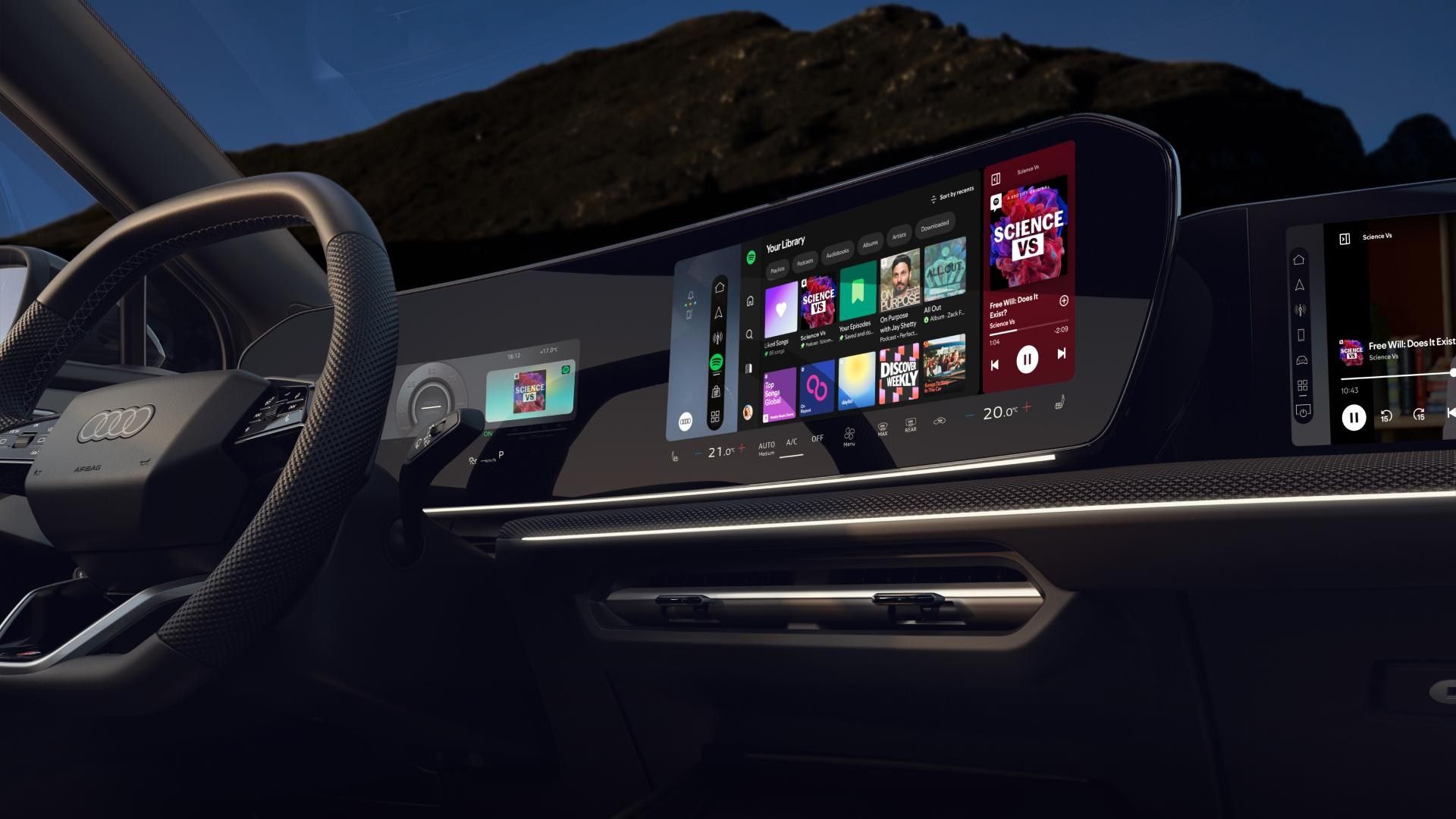
Spotify has begun moving into the car without relying on the phone to carry the service. The company announced the launch of its first fully native in-car app, built on Google’s Android Automotive operating system and initially available in select Audi models.
The important change is where the app runs. Instead of requiring users to connect a phone to the vehicle, Spotify’s new app operates directly on the car’s infotainment hardware.
What Changed
For eligible Audi users, Spotify says the native app removes the need to tether a phone, establish a Bluetooth connection or use an auxiliary cable. The car’s own software environment now handles the application directly.
That is more than a new interface for an existing phone-based service. It places Spotify within the vehicle’s operating system rather than treating the car as an extension of a connected handset.
The announcement is framed as Spotify moving beyond CarPlay. However, the supplied information does not include a detailed comparison between the new Android Automotive app and Spotify’s CarPlay experience, so the clearest supported conclusion is that Spotify now has a standalone automotive app without the phone-connection requirements listed above.
The Important Detail: It Is Native to the Car
“Native” here means that the app was built specifically for Android Automotive, the operating system used in the vehicle’s infotainment system. It is not simply a phone app displayed on the car’s screen.
For users, the practical benefit is fewer setup steps. There is no need to prepare a phone connection before using Spotify through the vehicle. The announcement also shows Spotify moving toward a model in which in-car listening is delivered by software designed for the car itself.
However, the launch should not be interpreted as proof of universal compatibility. The supplied material does not say that the app will work in every connected car, every Android Automotive vehicle or every Audi model.
Why It Matters
Spotify is one of the most established music services, and its move into native vehicle software changes its role in the car. The company is no longer dependent only on users bringing the service into a vehicle through their phones.
For Audi owners with supported vehicles, the immediate advantage is a more self-contained way to access Spotify. For Spotify, the launch demonstrates a direct route into vehicle infotainment systems, where the application can be integrated at the operating-system level rather than attached to a separate device.
It also represents a useful test of a wider automotive platform. Because the app is built on Android Automotive, the experience is tied to a specific in-car software environment. Audi’s supported models are therefore an important part of the story, even though the announcement does not provide the full model list.
What Remains Unclear
The supplied announcement leaves several practical questions unanswered:
- Which Audi models are included?
- In which countries will the app be available?
- Does it require a Spotify subscription or an active data connection?
- Which Spotify features will appear in the vehicle interface?
- Will the app expand to other Audi models or vehicle brands?
- How does the native experience differ from Spotify’s existing CarPlay offering?
No Nigerian or wider African availability is identified in the supplied information, so local access should not be assumed.
What to Watch Next
The next important signals will be the precise vehicle list, market availability and feature set. A wider rollout would show whether Spotify’s native approach is a limited experiment or part of a broader transition toward in-car software that does not depend on a connected phone.
No expansion timeline is provided, so it would be premature to describe the launch as a universal replacement for phone-based or CarPlay-based use.
VANTIX Takeaway
Spotify’s first native Android Automotive app matters because it runs inside the car rather than relying on several phone-connection methods to reach the vehicle. Its immediate reach is limited to select Audis, and the announcement’s missing model, market and feature details will determine how significant the move becomes.


