What happened
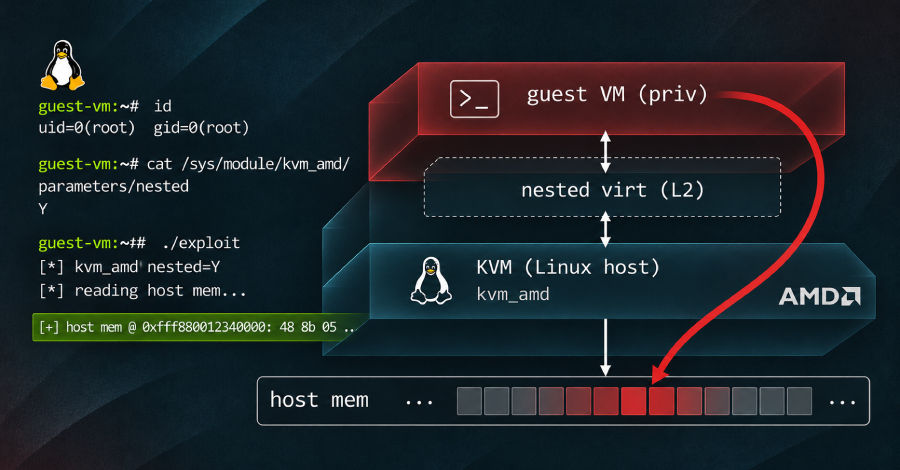
Researchers discovered a vulnerability in the KVM hypervisor, which is built into the Linux kernel, that allows a virtual machine to read large portions of the host’s memory. The issue, identified as CVE‑2026‑99312, was demonstrated on a DigitalOcean cloud server where a guest VM could read about 127 GB of memory.
Technical details
KVM (Kernel‑based Virtual Machine) runs directly on the host CPU. The flaw only affects systems using AMD processors and with nested virtualization enabled, a feature that lets a VM create its own VMs. In such configurations the hypervisor failed to properly isolate memory pages, letting a guest read host memory that may belong to other virtual machines on the same physical server.
Impact
Because the memory can contain data from other customers’ VMs on shared hosts, the bug could enable cross‑tenant information leakage. The amount of data that can be read up to 127 GB represents a significant portion of a typical cloud instance’s RAM.
Mitigation
Linux distributions have already shipped patched kernels that correct the isolation logic. Users should update to the latest kernel version to apply the fix.


