What Happened
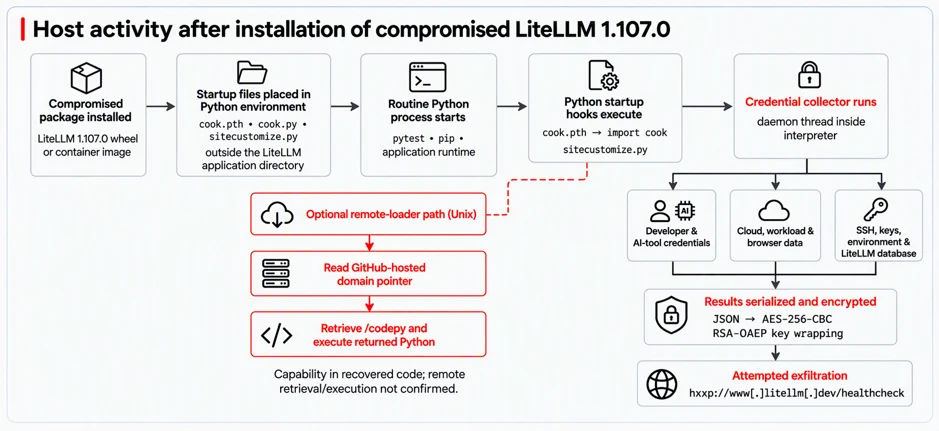
Microsoft Threat Intelligence has published an analysis of a supply chain compromise affecting LiteLLM 1.107.0. The attackers leveraged Python startup hooks—mechanisms that run code automatically when a Python interpreter starts—to steal credentials and achieve remote code loading. The findings are presented in the blog post titled "Inside the LiteLLM 1.107.0 supply chain compromise: Credential theft through Python startup hooks."
The Key Details
- Compromised version: LiteLLM 1.107.0
- Attack vector: Python startup hooks (e.g., `sitecustomize`, `usercustomize`) that execute malicious code at import time
- Impact: Credential theft and remote code loading, giving attackers access to sensitive authentication data and the ability to run arbitrary code in compromised environments
- Source: Microsoft Security Blog, authored by Microsoft Security Research team members Mahesh Mandava, Srinivasan Govindarajan, Sagar Patil, and Suriyaraj Natarajan
- Publication date: 23 October 2026
- Content covered: Technical analysis of the compromise, detection guidance, and recommended mitigations
Why It Matters
- Supply chain risk: Open‑source libraries like LiteLLM are widely used; a compromise can affect many downstream projects and users
- Powerful attack surface: Python startup hooks are a legitimate but often overlooked execution point, making them attractive to adversaries
- Credential exposure: Stolen credentials can be used to authenticate to APIs, cloud services, and other systems
- Remote control: Remote code loading provides attackers with full control over the compromised environment
- Actionable guidance: Microsoft’s analysis includes detection methods and mitigation steps that organizations can apply immediately
What It Means for Readers
- Developers using LiteLLM: Review dependency chains, monitor for unexpected startup behavior, and apply the mitigation steps outlined by Microsoft
- Security teams: Consider adding monitoring for Python startup hook activity and look for indicators of credential leakage
- Organizations relying on LLM services: Assess the risk of compromised libraries and strengthen supply‑chain security practices
What Happens Next
The blog does not announce a specific timeline, but the guidance is intended for immediate use. Organizations are encouraged to implement the recommended mitigations promptly to protect their deployments.
VANTIX Takeaway
The incident demonstrates how Python startup hooks can be weaponized in supply‑chain attacks. Staying vigilant about library integrity and applying security guidance from vendors is essential for protecting development environments and user data.
--- Tags: LiteLLM, Python, supply chain, credential theft, remote code loading, Microsoft Threat Intelligence, security


