# Attackers hijack five OVHcloud CLI releases to distribute secret‑stealing malware
What Happened
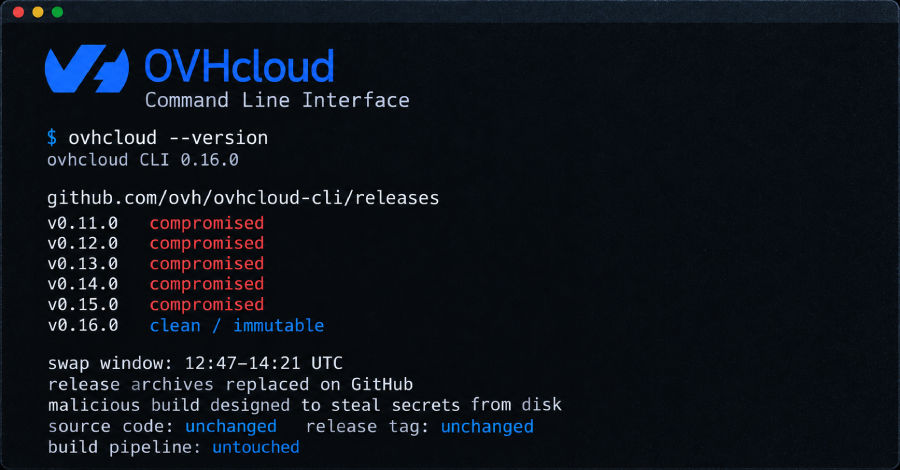
A cyber‑criminal gained control of a contributor’s GitHub account and used it to overwrite the download files for five current releases of OVHcloud’s command‑line interface (CLI) tool. The tampered archives were uploaded and remained publicly accessible on GitHub for roughly 94 minutes, between 12:47 and 14:21 UTC on Monday, October 19. OVHcloud confirmed that the new builds were crafted to steal secrets saved on the local disk of any system that ran the compromised tool.
The Key Details
- Date and time of the breach: Monday, October 19, 12:47–14:21 UTC (94 minutes).
- Vector: Compromise of a contributor’s GitHub account, which allowed the attacker to replace the legitimate download archives with malicious versions.
- Affected releases: Five existing releases of the OVHcloud CLI tool.
- Malware purpose: The modified builds were engineered to exfiltrate secrets stored on the disk of any machine that executed them.
- Source confirmation: OVHcloud stated that the incident was identified and reported by the company.
Why It Matters
The incident highlights how a single compromised developer account can turn a trusted open‑source project into a delivery mechanism for malware. Because the CLI tool is commonly used by developers and businesses to interact with OVHcloud services, the attack could expose authentication tokens, API keys, and other sensitive data that grant access to cloud resources. Even a short exposure window can be sufficient for an attacker to harvest credentials, especially if users automatically download and execute the tool without verifying its integrity.
What It Means for Readers
- Developers and technical users who rely on the OVHcloud CLI should verify the checksum or signature of any download before installing or updating the tool.
- Organizations that automate deployment scripts using the CLI may unintentionally propagate the malware across multiple machines, risking data leakage and service disruption.
- Security teams need to monitor for unexpected changes in the tool’s repository and consider implementing stricter access controls on contributor accounts.
- Open‑source maintainers are reminded that account security, including strong authentication and regular audits of repository access, is critical to prevent similar supply‑chain attacks.
What Happens Next
OVHcloud has not announced a specific timeline for releasing clean versions of the affected releases, but the company is expected to replace the compromised files with verified builds and notify users to re‑download the tool from a trusted source. Developers are advised to check the official OVHcloud channels for statements and to apply any patches or updated releases promptly.
VANTIX Takeaway
The breach underscores that the security of the software supply chain is as vulnerable as the endpoints it serves; users of the OVHcloud CLI must verify download integrity and stay vigilant about account security practices to avoid falling victim to malicious updates.
---
This article is based solely on the information provided by The Hacker News and OVHcloud’s public statement. No additional details or speculation have been introduced.


