What Happened
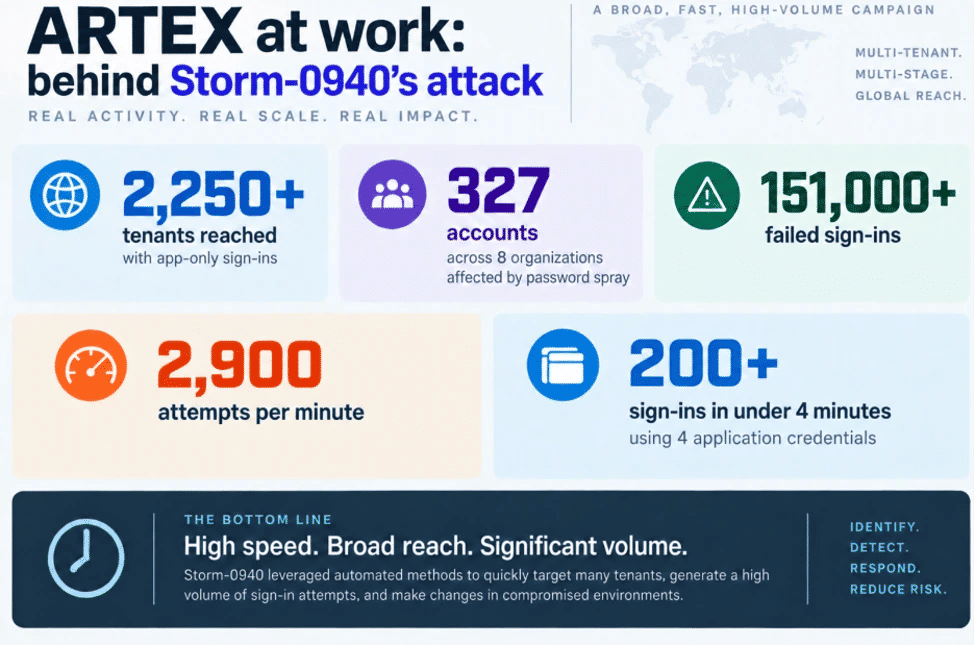
Microsoft Security Research and Microsoft Threat Intelligence report that the activity tracked as Storm-0940 used ARTEX—described in the supplied material as agentic AI—to accelerate a ConnectWise supply-chain compromise.
Microsoft characterises the operation as a large-scale nation-state campaign. According to the supplied report summary, the compromise enabled abuse of application credentials across Microsoft 365 environments. The combination makes this more than a story about AI-assisted cyber activity: it links that technology to a supply-chain operation with stated reach into cloud environments.
The important detail is that ARTEX reportedly accelerated the compromise. The available material does not explain which stages of the operation the AI handled, what techniques it enabled, or whether artificial intelligence was essential to the attack.
The Key Details
- Storm-0940: The designation used for the reported operation, which Microsoft describes as large-scale and nation-state.
- ARTEX: The agentic AI system credited with accelerating the campaign.
- ConnectWise: The company or supply chain identified in connection with the compromise.
- Application credentials: Credentials reportedly abused across Microsoft 365 environments after the supply-chain compromise.
The supplied material does not specify the number of affected organisations, industries, or countries. It also does not provide victim names, technical indicators, a detailed attack sequence, or information about data removal.
Why It Matters
Reported fact: The campaign combined a ConnectWise supply-chain compromise with application-credential abuse across Microsoft 365 environments, while Microsoft says agentic AI helped accelerate the operation.
Editorial interpretation: That combination widens the security issue beyond a single compromised system. Defenders cannot consider supplier access and cloud-service credentials separately when assessing how an operation like this could progress.
The AI element is notable because it reportedly helped speed up the activity. However, the available information does not justify broader claims about autonomous hacking, the scale of automation, or whether similar AI-assisted campaigns are occurring elsewhere.
Who Should Care
The clearest audience is security teams responsible for Microsoft 365 environments, as well as organisations that assess risk through their software and service suppliers. The report is relevant even to companies that cannot confirm exposure, because it provides a reason to examine how supplier relationships and application access are connected.
That advice should not be mistaken for a list of confirmed victims. The supplied material names no affected sector or organisation and provides no Nigeria- or Africa-specific breakdown. It therefore does not establish that a particular business, Nigerian organisation, or African institution was targeted.
What Remains Unknown
Several questions are necessary for understanding the campaign’s real impact:
- How was ARTEX deployed, and which parts of the attack did it automate or accelerate?
- How was the ConnectWise supply chain compromised?
- Which application credentials were abused, and how were they used within Microsoft 365 environments?
- How many organisations were affected, and in which countries and sectors?
- Was data accessed or taken, and what containment or remediation steps were recommended?
These gaps limit how confidently the campaign’s reach and consequences can be assessed from the supplied information alone.
VANTIX Takeaway
Microsoft’s central claim is that ARTEX agentic AI helped accelerate a nation-state supply-chain compromise involving ConnectWise, followed by application-credential abuse across Microsoft 365 environments. The combination is significant, but the missing technical and victim details are equally important for understanding the direct impact.


