What Happened
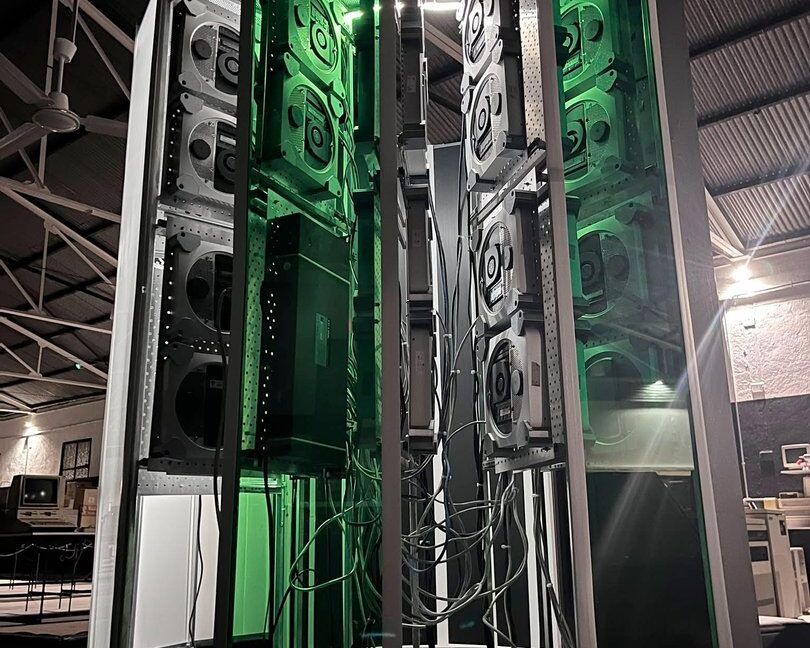
A computer history museum in Spain has recreated one of computing's most recognizable machines — the Cray-1 supercomputer — using hardware that most people would consider electronic waste. The Museo de Historia de la Computación assembled 30 Mac Minis released between 2012 and 2014 into a 1:1 scale replica that not only looks like the original but actually runs as a functioning parallel cluster.
The Key Details
The hardware: Five quad-core i7 Mac Minis and 25 dual-core i5 models, all from 2012 except two 2014 units. Together they provide 64 active processing cores (70 before one node failed).
The performance: The cluster achieves 1.3 teraflops in recent benchmarks using a custom Python matrix-multiplication script. An earlier test with all 70 cores reached 1.5 teraflops.
The original Cray-1: Released in 1976, it peaked at approximately 160 megaflops using vector processing — applying a single instruction across multiple data elements simultaneously.
The architecture difference: The replica uses a parallel cluster model, distributing work across independent processors. This is fundamentally different from the Cray-1's vector approach, yet the consumer hardware outperforms the purpose-built research machine by roughly four orders of magnitude.
Software choice: Rather than Linux, the team runs macOS Mojave (10.14), leveraging its built-in MPI (Message Passing Interface) support to coordinate tasks across nodes.
Cooling: A steel rack chassis with aluminum tray mounts enables passive convection cooling. The system runs nearly silently — a stark contrast to both the original Cray-1's elaborate Freon cooling and modern data center noise.
Timeline: Development took 18 months as a 50th-anniversary tribute to both the Cray-1 and Apple's 1976 founding.
Why It Matters
This project illustrates a profound shift in computing economics and architecture. The Cray-1 cost millions of dollars (equivalent to tens of millions today), required specialized facilities, and represented the absolute frontier of performance. Today, a museum can assemble a visually faithful replica with dramatically superior performance using discarded consumer desktops.
The contrast in cooling is equally telling. The original Cray-1's horseshoe shape wasn't aesthetic — it minimized wire lengths for speed and accommodated a complex Freon refrigeration system. The replica achieves comparable thermal management with passive aluminum trays.
For computer architecture students and enthusiasts, the exhibit makes abstract concepts tangible: vector vs. parallel processing, the evolution of interconnects (MPI over Ethernet vs. Cray's proprietary channels), and the staggering density gains from 1976-era ECL logic to 2012-era Intel Core processors.
What It Means for Readers
For technology enthusiasts: A vivid demonstration of how far commodity hardware has come. The Mac Minis used here were mid-range consumer desktops over a decade ago.
For educators and students: A physical teaching tool that shows parallel cluster principles in action. Visitors can watch workloads scale from a single core to the full 64-core array in real time.
For sustainability advocates: An example of creative upcycling. Hardware destined for e-waste becomes an educational asset with genuine computational utility.
For African tech contexts: While this specific exhibit is in Spain, the principle — building capable clusters from affordable, older hardware — resonates in resource-constrained environments where maximizing the utility of existing equipment is practical necessity.
What Happens Next
The replica remains on permanent display at the Museo de Historia de la Computación. Visitors can observe live matrix computations and the system's scaling behavior. The museum has not announced plans to expand the cluster or replace the failed node.
VANTIX Takeaway
The Cray-1 replica proves that yesterday's "obsolete" consumer hardware collectively outperforms yesterday's multi-million-dollar supercomputer by thousands of times — and does it silently, on passive cooling, in a form factor that fits in a museum gallery. The most powerful supercomputer of 1976 is now a classroom demonstration built from e-waste.


